
The formulations in the declaration in reference to terrorism is going to be to our "satisfaction", Dammu Ravi, secretary (economic relations) in the external affairs ministry said on Monday.

'After announcing that she will return to Bangladesh, if she does not, her credibility will suffer.'

Bangladesh has once again sought the extradition of former premier Sheikh Hasina from India during High Commissioner Dinesh Trivedi's first meeting with Prime Minister Tarique Rahman in Dhaka, amidst fresh strains in ties between the two countries following Hasina's controversial virtual media interaction in New Delhi.

The prime minister also said that country nurtures a mindset that loudly proclaims that terrorism is justified for political gains.
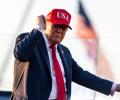
President Trump threatens to impose a 10% tariff on countries aligning with BRICS anti-American policies. This follows BRICS criticism of increased tariffs. Trump also announced tariff letters to various countries.

Lavrov's comments came two days after Russia accused the US of attempting to prevent India and other countries from buying Russian oil, saying Washington was using a wide range of 'coercive' measures, including tariffs, sanctions and direct prohibitions.

South Africa's Deputy International Relations and Cooperation Minister Marius Fransman said this would give a major boost to some of the development needs of these countries.
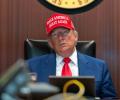
China defended the BRICS economic alliance, stating it is not a bloc for confrontation, after former US President Donald Trump threatened tariffs on countries aligning with its 'anti-American policies'.
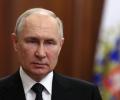
Russian President Vladimir Putin will not personally attend the G20 summit to be held in New Delhi on September 9-10, Kremlin Spokesman Dmitry Peskov announced in Moscow on Friday.

The BRICS nations have expressed concern over the proliferation of trade-restrictive actions in the form of 'indiscriminate rising' of tariffs, particularly measures used as a means of 'coercion', cautioning that such practices risk marginalising the Global South countries.

We are back to the 1971 moment with both China and the US supporting Pakistan, asserts Colonel Anil A Athale (retd).
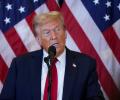
President Donald Trump on Tuesday claimed that BRICS was established to "hurt" the US and "degenerate" the dollar as he warned that the member countries of the bloc would face a 10 per cent tariff. Trump made the remarks while talking to reporters at the sixth Cabinet meeting at the White House.

The agenda is to give a concrete shape to a Development Bank and pitch for reforms of the UN Security Council.

National Security Adviser Ajit Doval held "constructive" talks with Chinese Foreign Minister Wang Yi in New Delhi, focusing on the normalisation of bilateral ties. The discussions reviewed recent developments and progress towards rebuilding trust after the eastern Ladakh border standoff. Both sides have implemented measures, including disengagement pacts and high-level meetings, to improve relations.

The theme of the Summit is "BRICS Partnership for Global Stability, Security and Prosperity". Prime Minister Dr Manmohan Singh will host President Dilma Rousseff of Brazil, President Dimitry Medvedev of Russia, President Hu Jintao of China and President Jacob Zuma of South Africa at the Summit.


India is navigating a complex diplomatic landscape, attempting to balance its 'forever honeymoon' with the Israel-UAE-Bahrain axis against its historical ties with Iran, as evidenced by recent high-level visits and evolving geopolitical realignments in the Middle East, observes Ambassador M K Bhadrakumar.

The hotel has currently turned into a high security zone with guests living there moved out to other facilities of the Taj group.
Set to get elected next week as China's new President, Xi Jinping will hold his first bilateral meeting with Prime Minister Manmohan Singh on the sidelines of the BRICS (Brazil, Russia, India, China and South Africa) summit to be held later this month in South Africa.

Chief Economic Adviser V Anantha Nageswaran on Wednesday said that the country is not pursuing any proposal to replace the US dollar as international currency for global trade. "No, certainly not. I think India is not part of any such initiative," he said in response to a question if India is looking at an alternative currency to the US dollar for global trade.

Prime Minister Narendra D Modi with Brazil's President Luiz Inacio Lula da Silva, China's President Xi Jinping, South African President Cyril Ramaphosa and Russia's Foreign Minister Sergei Lavrov at the BRICS Summit in Johannesburg, South Africa.

In a joint declaration issued after the 16th BRICS Summit in the Russian city of Kazan attended by Prime Minister Narendra Modi and Chinese President Xi Jinping, among others, the leaders reiterated unequivocal condemnation of terrorism in all its forms and manifestations while reaffirming that it should not be associated with any religion, nationality, civilisation or ethnic group.

Describing the visit as "productive" in a post on X, the PM said he emphasised India's position on key global issues during his engagements.

Prime Minister Manmohan Singh on Thursday left Durban for home, ending a four-day visit during which he attended BRICS (Brazil, Russia, India, China and South Africa) Summit that decided to establish a development bank to finance infrastructure projects in emerging economies.

Kazan in Tatarstan, south west Russia, is where the annual BRICS summit will be held this week.

Prime Minister Narendra Modi spoke with Iranian President Masoud Pezeshkian, condemning attacks on critical infrastructure in West Asia and emphasising the importance of safeguarding freedom of navigation and ensuring secure shipping lanes.
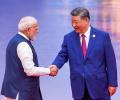
India's dual pursuit of a robust strategic partnership with Washington and a pragmatic, tension-management policy with Beijing represents the essence of modern multi-alignment. By embracing economic pragmatism, learning to compartmentalize political differences, and engaging in continuous dialogue, India can secure its borders, grow its economy, and contribute to a stable, multipolar Asian century, points out Ambassador Rajasekhar.

Russian President Vladimir Putin and Chinese President Xi Jinping have reaffirmed their commitment to dismantling global hegemonism and building a 'multipolar world' during high-level talks in Beijing.

Reflecting close ties between India and Russia and his personal rapport with Prime Minister Narendra Modi, Russian President Vladimir Putin quipped during their bilateral meeting on Tuesday that they have such a relationship that Modi will not need a translator.

Prime Minister Narendra Modi said he looks forward to useful conversations with his fellow leaders from China, South Africa, Brazil and Russia on addressing pressing international and regional challenges that stand in the way of their goals.

Prime Minister Narendra Modi spoke with Iranian President Masoud Pezeshkian to discuss the escalating tensions in West Asia, emphasising the safety of Indian nationals and the need for regional stability through dialogue and diplomacy.

The BRICS nations condemned the Pahalgam terror attack, advocated for a zero-tolerance approach to terrorism, and criticized rising tariffs during their summit in Rio de Janeiro. They also addressed global challenges and called for reforms in international institutions.

Prime Minister Narendra Modi and Chinese President Xi Jinping are expected to hold bilateral meetings on the sidelines of the SCO summit in Tianjin, as both nations look to strengthen ties amid global trade tensions.

Asked about the recent meeting between Modi and Xi, and if Russia had any role in it, Alipov said, "We have not played any role in it, but we are happy that it took place in Kazan... We wholeheartedly welcome the meeting."

The 16th Brics Summit beginning Tuesday in Kazan, Russia, is expected to see more focus on creating a sharper energy policy for Brics that ensures closer partnership among members in both energy security and energy transition, official sources said. The same is expected to be a part of the Kazan declaration, currently being negotiated, they added.
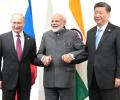
For the first time since the standoff between Indian and Chinese troops along the Line of Actual Control (LAC) in eastern Ladakh, Prime Minister Narendra Modi and Chinese President Xi Jinping are expected to come face-to-face virtually at the BRICS (Brazil-Russia-India-China-South Africa) annual summit to be held on November 17.

India should not stay on the margins of this initiative. There should be a serious debate about what would be in India's best interests asserts former foreign secretary Shyam Saran.

A meeting with Chinese President Xi Jinping on the sidelines of the SCO summit is being planned.
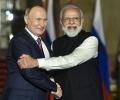
Russian President Vladimir Putin will travel to India in December, Kremlin foreign policy aide Yuri Ushakov said. Putin will meet Prime Minister Narendra Modi on the sidelines of the Shanghai Cooperation Organisation (SCO) Summit in China's Tianjin city to discuss the preparations for his visit to India.
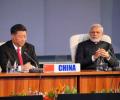
China on Thursday said Beijing views the BRICS as an "open and inclusive" platform and it backs moves to expand the five-member grouping with "like-minded partners".
